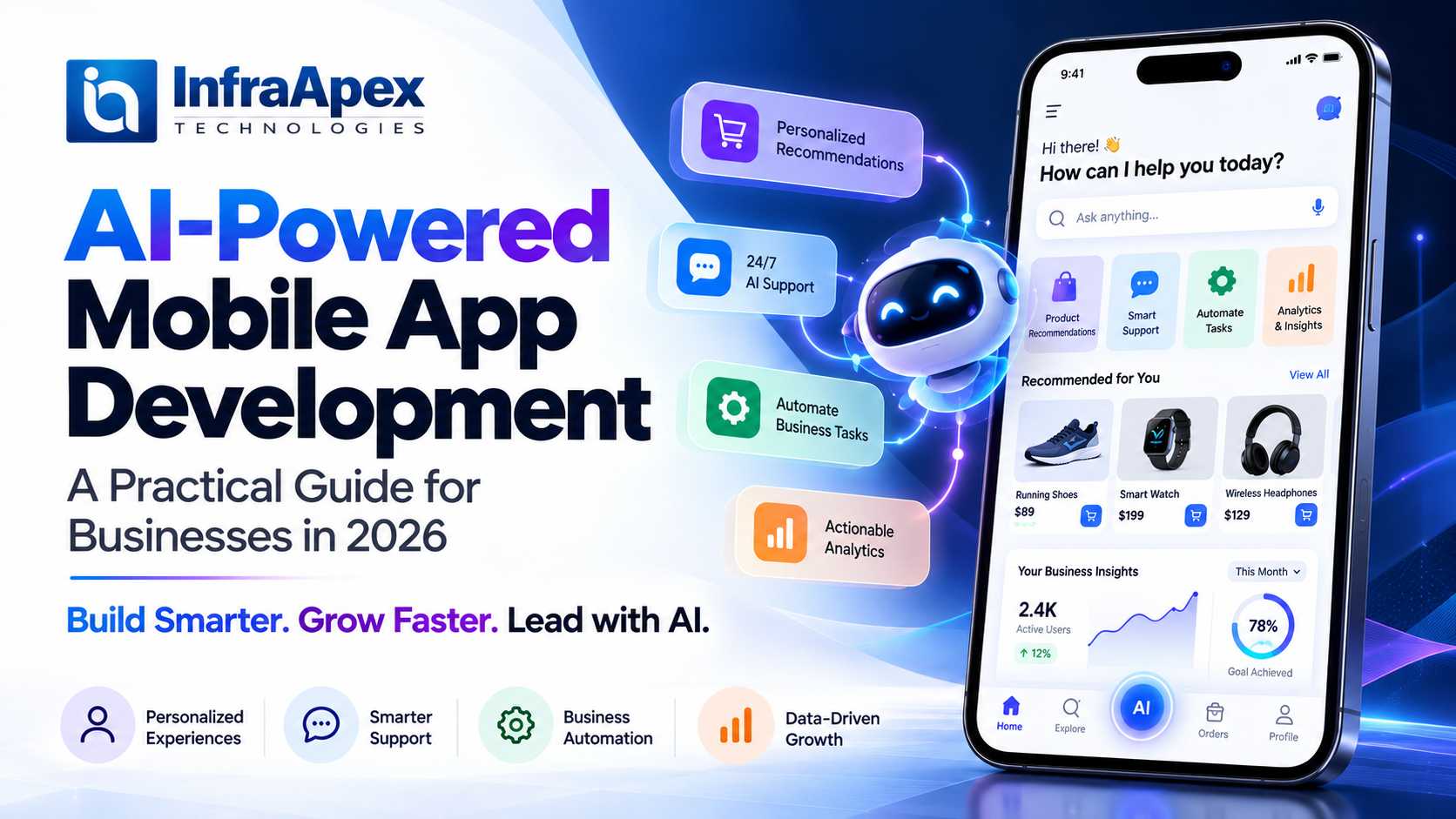
Why Businesses Are Investing in AI-Powered Mobile Apps
Think about the apps you use every day. Shopping apps recommend products you might like. Banking apps identify unusual transactions. Virtual assistants answer questions within seconds.
What makes these experiences different? Artificial intelligence (AI).
Businesses are now using AI to create mobile applications that do more than perform basic tasks. They can personalize user experiences, automate repetitive work, improve customer support, and help teams make better decisions.
The best part? You don't need to be a large technology company to benefit from AI. Startups, small businesses, and growing enterprises can integrate AI into new or existing mobile applications based on their needs and budget.
At InfraApex, we help businesses explore practical technology solutions that solve real problems and support long-term growth.
In this guide, you'll learn what AI-powered mobile app development means, which features deliver business value, how the development process works, and what to consider before investing.
What Is AI-Powered Mobile App Development?
AI-powered mobile app development is the process of building mobile applications that use artificial intelligence to perform tasks such as understanding language, recognizing images, analyzing data, and generating useful responses.
Traditional apps generally follow predefined rules. AI-powered apps can use trained models to handle more complex inputs and provide context-aware results.
For example:
-
An e-commerce app can recommend products based on customer preferences.
-
A customer service app can answer common questions using an AI assistant.
-
A logistics app can analyze delivery data to help improve planning.
-
An education app can recommend learning resources based on a student's progress.
AI technologies commonly used in mobile applications include:
-
Machine learning: Identifies patterns in data and supports predictions.
-
Natural language processing: Helps applications understand and process human language.
-
Generative AI: Generates text, summaries, responses, and other content.
-
Computer vision: Analyzes images and video.
-
Speech AI: Enables voice commands, transcription, and voice-based interactions.
Not every mobile app needs all these technologies. The right choice depends on your business objectives, users, available data, and budget.
6 Business Benefits of AI-Powered Mobile Apps
AI is most valuable when it delivers a clear improvement in how a business operates or serves its customers.
Here are six ways it can help.
1. Personalize the Customer Experience
Customers are more likely to engage with an app when it provides relevant information and recommendations.
AI can analyze appropriate user interactions and preferences to personalize the experience.
For example, an online shopping app can recommend relevant products, while a learning app can suggest courses based on a user's interests and progress.
Business benefit: More relevant experiences, improved product discovery, and opportunities to increase conversions.
2. Improve Customer Support With AI Chatbots
Customers often need answers outside regular business hours. AI chatbots can respond to common questions, guide users through an application, and provide assistance at any time.
A well-designed chatbot can also direct complicated requests to a human support team with the relevant conversation context.
Business benefit: Faster responses, reduced repetitive support work, and a more convenient customer experience.
3. Automate Repetitive Tasks
Many businesses spend hours processing documents, categorizing requests, summarizing conversations, and handling routine administrative work.
AI can help automate parts of these workflows.
For example, a business app could extract information from invoices, summarize customer feedback, or categorize incoming support tickets.
Business benefit: Less manual effort, improved productivity, and more time for employees to focus on higher-value work.
4. Make Better Business Decisions
AI-powered analytics can help businesses identify patterns in customer behavior, forecast demand, and understand where users encounter difficulties.
For example, an app can help a business identify where customers abandon a checkout process or which features receive the most engagement.
Business benefit: Better-informed decisions, more efficient processes, and clearer opportunities for improvement.
5. Increase Customer Engagement and Retention
Acquiring new customers is important, but encouraging existing customers to return is equally valuable.
AI can support relevant notifications, personalized content, intelligent search, and recommendations based on user needs.
For example, a fitness app might suggest a suitable next activity, while an education app could recommend the next lesson in a course.
Business benefit: More useful interactions, stronger customer relationships, and opportunities to improve retention.
6. Create New Revenue Opportunities
AI can help businesses improve product discovery, introduce premium features, and make purchasing journeys more convenient.
Potential applications include AI-powered product recommendations, paid virtual assistants, intelligent search, and personalized service suggestions.
Business benefit: New product opportunities and the potential to improve conversion rates and revenue.
AI does not guarantee higher sales or lower costs. Results depend on implementation quality, user needs, and how well the solution addresses a genuine business problem.
Traditional Mobile Apps vs. AI-Powered Mobile Apps
How does an AI-powered app differ from a traditional application?
| Feature | Traditional app | AI-powered app |
|---|---|---|
| User experience | Predefined workflows | Can provide context-aware experiences |
| Recommendations | Fixed rules and filters | Can personalize recommendations |
| Customer support | FAQs and scripted responses | Can support conversational assistance |
| Data analysis | Reports on historical data | Can identify patterns and support predictions |
| User input | Forms, buttons, and menus | Can also process text, images, or voice |
| Automation | Rule-based tasks | Can assist with more complex information processing |
Important: AI does not replace traditional software engineering. Most successful applications combine reliable application logic with AI features where they offer genuine value.
How to Build an AI-Powered Mobile App: 6 Steps
Building an AI mobile application requires a clear plan, the right technology, and a focus on user needs.
Step 1: Define Your Business Goals
Start by identifying the problem you want to solve.
Do you want to improve customer support, automate internal processes, personalize recommendations, or launch a new digital product?
Set measurable goals before choosing AI technologies.
For example, you might aim to reduce the time required to resolve routine customer questions or increase the percentage of users who complete a purchase.
Step 2: Plan Your Minimum Viable Product (MVP)
An MVP is an initial version of your application that includes the essential features needed to test the idea.
Instead of building everything at once, prioritize the core user journey and one high-value AI feature.
This approach helps you validate demand, gather feedback, and manage initial development costs.
A focused MVP may take around 10–16 weeks, depending on scope, integrations, design, and testing requirements. More complex projects may take longer.
Step 3: Choose the Right Technology Stack
Your technology stack affects performance, development speed, maintenance, and scalability.
Common choices include:
-
Mobile development: Flutter, React Native, Swift, or Kotlin.
-
Backend development: Node.js, Python, Laravel, or other suitable frameworks.
-
Databases: PostgreSQL, MySQL, or MongoDB.
-
AI integration: Hosted AI APIs, machine learning services, or custom models.
-
Cloud infrastructure: Services for hosting, storage, security, and monitoring.
The best stack depends on your application requirements, existing systems, team expertise, and long-term goals.
Step 4: Integrate AI Securely
AI integration requires careful attention to security, privacy, and reliability.
Good practices include keeping secret API keys on the server, applying appropriate access controls, encrypting sensitive data, and limiting access to information the AI service actually needs.
For applications handling regulated or sensitive data, assess applicable legal and industry requirements before launch.
You should also plan for inaccurate AI responses, service interruptions, usage limits, and fallback options.
Step 5: Test the Application Thoroughly
Before launch, test both the mobile app and its AI capabilities.
This includes:
-
Functional and usability testing.
-
Performance and security testing.
-
AI response quality and accuracy evaluation.
-
Testing unusual or unexpected user inputs.
-
Testing failure handling and human escalation.
-
Monitoring response times and AI operating costs.
Testing should continue after launch as real users reveal new requirements and edge cases.
Step 6: Launch, Measure, and Improve
After launch, track whether the application achieves its original business goals.
Depending on the product, useful metrics may include customer retention, conversion rates, support resolution time, task completion, customer satisfaction, and cost per AI interaction.
Use these findings to improve the experience, refine AI behavior, and prioritize future features.
How Much Does AI-Powered Mobile App Development Cost?
The cost of AI-powered mobile app development depends on the features, platforms, integrations, design, security requirements, and complexity of the AI solution.
A focused MVP using an existing AI API generally costs less than a large application with multiple AI workflows, custom machine learning models, or complex enterprise integrations.
Your budget should account for more than initial development.
Consider these cost categories:
-
UI/UX design and mobile app development.
-
Backend APIs and database development.
-
AI model or API usage.
-
Cloud hosting and storage.
-
Security testing and deployment.
-
Ongoing maintenance and improvements.
AI API usage and cloud expenses can increase as the number of users grows, so these costs should be estimated early.
Our recommendation: Start with the business outcome you want to achieve, identify the smallest useful solution, and request an estimate based on clearly defined requirements.
This approach makes it easier to compare proposals and avoid paying for features your customers may not need.
Why Choose InfraApex for AI-Powered Mobile App Development?
Choosing a development partner is about more than selecting a technology stack. You need a team that understands your business requirements and can turn them into a practical, reliable solution.
At InfraApex, we help businesses develop digital products and integrate modern technologies to address real operational and customer challenges.
Our services include:
Custom Mobile App Development
Build mobile applications around your business model, target users, and product requirements.
AI Integration Services
Add suitable AI capabilities to new or existing applications, including conversational assistants, content processing, and intelligent workflows.
Backend and API Development
Develop the backend systems, APIs, and integrations required to support your application.
Business Process Automation
Identify opportunities to reduce repetitive work and improve operational efficiency through software and AI.
Application Modernization
Improve existing applications by introducing new functionality, updating architecture, and integrating AI where it makes sense.
Our approach begins with understanding your goals, evaluating the requirements, and recommending a solution that fits your needs and budget.
We focus on building maintainable software with a clear purpose—not adding AI simply because it is popular.
Frequently Asked Questions About AI Mobile App Development
1. How long does it take to build an AI-powered mobile app?
A focused MVP may take approximately 10–16 weeks. A larger application with multiple integrations and advanced AI capabilities may take several months or longer. The timeline depends on the project scope and requirements.
2. How much does an AI-powered mobile app cost?
There is no single price for every project. Costs depend on the features, platforms, integrations, and AI technologies involved. A detailed scope is the best starting point for an accurate estimate.
3. Do I need my own data to build an AI app?
Not always. Many applications can use existing AI models through APIs. Your own data may become useful for personalization, retrieval-based applications, or custom models, provided it can be used lawfully and securely.
4. Can AI be added to an existing mobile app?
Yes. AI features such as chatbots, intelligent search, recommendations, and document processing can often be integrated into existing applications. The feasibility depends on the current architecture, available data, and security requirements.
5. Which technology is best for AI mobile app development?
There is no universally best technology. Flutter and React Native support cross-platform development, while Swift and Kotlin are suitable for native iOS and Android applications. Backend frameworks and AI services should be selected according to the project's needs.
6. Is AI safe to use in a mobile application?
AI can be integrated securely, but it requires appropriate safeguards. Businesses should protect sensitive data, secure API credentials, control access, evaluate model outputs, and provide human review when necessary.
7. Can a startup afford AI-powered mobile app development?
Yes, depending on the idea and scope. Startups can begin with a focused MVP using existing AI services and expand the application as they validate demand and business value.
Ready to Build an AI-Powered Mobile App?
Your next mobile application could help you serve customers more effectively, simplify operations, or introduce an entirely new digital service.
The first step is to identify the opportunity and choose the right solution.
InfraApex helps businesses turn ideas into custom mobile applications with practical AI integration and reliable backend engineering.
Whether you are planning a new app, improving an existing product, or exploring AI automation, our team can help you evaluate the requirements and define the next steps.
Have an AI app idea? Let's discuss it.
Contact InfraApex to share your business goals and explore a suitable development approach, estimated timeline, and project scope.
Build smarter. Solve real problems. Grow with technology.